
LiftMaster Error Codes Explained: Flashing Lights & What They Mean
LiftMaster openers talk in flashes — the opener light, the arrow LEDs on the motor unit, the wall panel. Here's what the common patterns usually mean, the fixes that match them, and the honest caveat that codes vary by model.
On most LiftMaster openers, flashing lights point straight at the failure: the opener light flashing as the door reverses usually means photo-eye sensor trouble, while up-arrow flash counts on the motor unit map to faults like broken sensor wiring. Codes vary by model, so confirm counts against your manual on liftmaster.com.
LiftMaster is the opener brand we service most in Los Angeles — it and its Chamberlain siblings have been the valley's default for two decades of tract-home builds and replacements. When one faults, it doesn't display words; it blinks. The opener light flashes, the arrow LEDs on the motor unit blink in counted bursts, the wall panel glows colors. It's a genuinely useful system once you know the language — with one big caveat we'll repeat throughout: exact meanings vary by model, so treat this page as a field guide and confirm against your unit's manual at liftmaster.com.
How LiftMaster Reports Errors
Three different lights can flash, and they're not reporting the same things:
- The opener light (the big bulb under the motor unit). Flashing as the door refuses to close is the classic photo-eye sensor alert.
- The arrow LEDs on the side of the motor unit. On Security+ 2.0-era units, the up and down arrows blink in counted patterns that map to specific faults — this is LiftMaster's real diagnostic code table.
- The learn button LED, used mainly for programming remotes but also a clue for receiver problems.
The Flash-Code Table
These are the patterns we're called out for most, with the fixes that usually resolve them. Count the up-arrow flashes between pauses, then find your row — and remember the model caveat:
| Pattern | Usual meaning | Fix |
|---|---|---|
| Opener light flashes, door reverses while closing | Photo-eye sensors blocked or misaligned | Clean lenses, realign until both sensor LEDs hold steady |
| Up arrow flashes 1x | Sensor wire broken or disconnected | Inspect the bell wire run for staples or breaks; repair the circuit |
| Up arrow flashes 2x | Sensor wires shorted or reversed at the motor unit | Correct the connection at the opener terminals |
| Up arrow flashes 3x | Wall control (door control) wiring short | Check the wire from the opener to the wall button |
| Up arrow flashes 4x | Sensors briefly misaligned (eyes activated) | Realign; check for anything entering the beam path |
| Up arrow flashes 5x | Motor overheated | Let the unit cool; reduce back-to-back cycles; check the door's balance |
| Up arrow flashes 6x | Internal circuit failure | Professional diagnosis — board or motor assembly |
| Opener light flashes 10x (many models) | Sensor circuit fault on that model family | Confirm in the manual; full sensor and wiring check |
| No LEDs, no response | No power | Check outlet, GFCI, and breaker before anything else |
| Wall panel dark, opener works by remote | Wall control or its wiring failed | Replace the wall control or its wire run |
If the honest framing hasn't landed yet, let it: two different LiftMaster units in two neighboring Encino garages can use different code tables. The table above matches the common Security+ 2.0-generation residential units we see daily; wall-mount models, jackshaft openers, and older Security+ units have their own charts, printed on the motor unit's label or in the manual at liftmaster.com. When a homeowner reads me a flash count over the phone, I can usually name the likely fault — but I still verify on a ladder.
The most common call of all
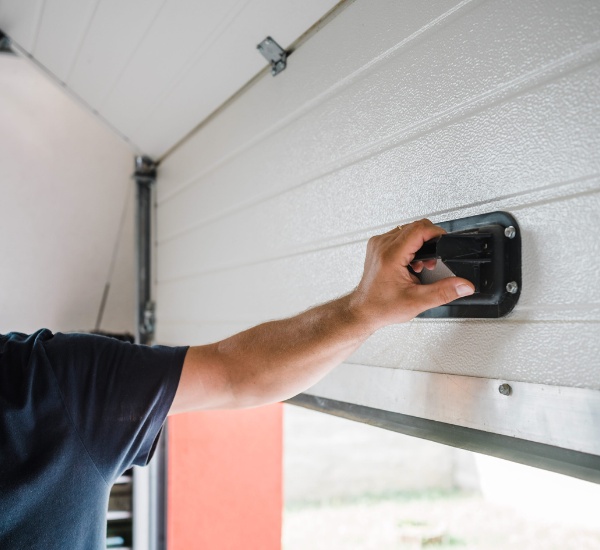
Number one, by a wide margin: the opener light flashing as the door refuses to close — the sensor pattern. Nine times in ten it's a lens gone dusty or a bracket knocked by a trash can. It's also the one code most owners can clear themselves in two minutes.
Our sensor repair service handles the other one time in ten.
The Learn Button: Resets and Reprogramming
The learn button — usually a small square button on the motor unit's side or rear panel, under the light cover on older units — is for programming, not diagnostics, but two resets live here. A short press (release, then press the remote) adds a remote; holding it about six seconds until the LED goes out erases everything stored, which is the move when a stray or forgotten remote needs eviction. After a full erase, reprogram every remote and keypad. If the learn LED won't light at all, the logic board or its power supply is suspect — that's a technician visit, and it's also the point where opener age starts to matter against the repair-versus-replace math.
When myQ Goes Offline
The myQ app failing isn't an opener fault code — it's almost always the connection chain. Work it in order: confirm the opener has power and the door still runs from the wall button; check the myQ hub's LED (a solid light wants a green internet indicator); verify the home's Wi-Fi is up and the router hasn't changed bands or passwords since setup; then power-cycle the hub. Persistent offline with a working opener usually means a hub that has dropped off the network for good. The step-by-step walkthrough lives in our myQ troubleshooting guide.
Brand Confusion: LiftMaster vs Chamberlain
The two brands share a parent and most of their engineering, which matters here because Chamberlain units at big-box stores often use the same diagnostic flash patterns described above. The differences are in model lines, warranty channels, and who sells what where — the comparison in our LiftMaster vs Chamberlain guide covers it properly.
"Very professional, would recommend his service" — Chong Li, Google Review
When to Call a Pro
Cleaning lenses, realigning sensors, erasing and reprogramming remotes, checking the outlet: safe homeowner territory. Everything past that — wiring shorts, board faults, motor overheat patterns, opener repairs that keep returning the same code — belongs with a technician, both for safety and because misreading a code leads to buying parts you don't need. Our LiftMaster opener repair service runs Monday through Friday, 8 AM to 6 PM, across the Valley and greater LA; most opener repairs land in the $100 to $300 range once the flash count has named the fault. Call (818) 919-0785 for a free on-site estimate.
LiftMaster Opener FAQs
The flash-code questions we answer most on opener calls.
On many LiftMaster models, the opener light flashing ten times as the door tries to close points at the photo-eye sensor circuit — blocked, misaligned, or a wiring fault on that circuit. Because meanings vary by model family, confirm the count against your unit's manual at liftmaster.com, or start with the free fix: clean both lenses and realign until both sensor LEDs hold steady.
For remotes, press and release the learn button, then press the remote button once. To fully erase all stored remotes and keypads, hold the learn button about six seconds until the LED goes out, then reprogram each device. A factory reset of the opener's settings is a different procedure by model and is usually unnecessary for flash-code faults.
The up and down arrows on Security+ 2.0-era units blink in counted patterns that map to specific faults: one up-flash typically flags broken sensor wiring, two flags shorted or reversed sensor wires, three a wall-control wiring short, five a motor overheat, six an internal circuit failure. Count the flashes between pauses and compare with the chart on the motor unit or your manual.
Some do — a motor-overheat code clears once the unit cools, and a brief sensor interruption resets once the beam path is clear. Wiring, board, and motor faults do not self-clear, and repeatedly cycling the door on a fault risks converting a small repair into a larger one. If a code returns after the basic fixes, have it diagnosed.
Most LiftMaster repairs land between $100 and $300 once the flash code has identified the fault — sensor and wiring work at the lower end, board and motor work higher. Diagnosis is free as part of our on-site estimate, and we quote before any work begins.
Largely, yes — the brands share a parent company and much of their diagnostic logic, so the common patterns are similar. Model lines differ, though, so Chamberlain units can deviate on specifics. Our LiftMaster vs Chamberlain guide covers which lines differ and where.
Keep Reading
More guides from the EM Garage Doors team.