
Why Does My Garage Door Open by Itself?
A garage door that runs on its own usually has a stuck remote, a shorted wall button, a neighbor on an old fixed code, or a failing logic board. Here is how to corner the cause — and when to hand it to a pro.
A garage door that opens by itself usually has a stuck remote button, a shorted wall-button wire, or a neighbor's opener sharing an older fixed code. Erase and reprogram the remotes first. If it keeps happening, the wall wiring or logic board needs professional diagnosis.
You didn't touch anything. The door was closed at bedtime and open when you backed out in the morning. A garage door that opens by itself should be unsettling: an opener running without a command is a security problem until you find the cause. The good news — phantom operation almost always traces to one of four fixable things.
Phantom-operation calls are a steady trickle of our work in Sherman Oaks and Encino, usually where a 1990s opener is still riding its original rail. Here's what we find, most to least common.
Four Reasons a Garage Door Opens by Itself
1. A stuck remote button
The number-one cause we see. A remote wedged in a car console or buried in a kitchen drawer gets its button held down by coins, keys, or the drawer itself. Some remotes transmit continuously while the button is pressed, and the opener responds as if someone were standing there. Remotes left on sun-baked dashboards also warp, leaving buttons half-depressed. Pull the batteries from every remote, one at a time; when the phantom runs stop, you've found your ghost.
2. Frequency overlap on older fixed-code openers
Openers built before the mid-1990s used fixed codes set by dip switches inside the remote and receiver. There were only so many combinations, and every manufacturer shared the same handful of frequency bands. If a neighbor's remote matches or comes close to your code, their signal can trip your door. Modern openers use rolling codes that change with every press, which is why this barely exists on anything newer. If your remote has dip switches, this is a prime suspect.
3. A shorted wall button or its wiring
The wall button connects to the opener with thin bell wire, often pinched under staples along the garage framing. When that wire shorts — a staple through the insulation, moisture, a knock from stored gear — the opener reads it as a button press. Disconnect the wall-button wires at the opener (power off) and run the door from remotes only for a few days. If the phantom stops, the wall circuit is the culprit.
4. A failing logic board
The least common cause, but a real one. Power surges — Los Angeles gets them, especially when the grid is stressed ahead of Santa Ana wind events — can corrupt the board that runs the opener. A damaged board fires random commands, blinks lights, or runs the door at odd hours. There is no homeowner fix; it takes a technician to confirm and replace it.
Start With a Full Remote Reset
Before assuming hardware failure, clear the slate. Hold the learn button on the motor unit until the LED goes out — usually six seconds — which erases every remote and keypad the opener has memorized, then reprogram each remote fresh. This removes stray or overlapping codes the receiver has collected, and costs nothing but ten minutes. Our remote troubleshooting guide walks through the sequence, and if a remote is worn out, our remote replacement service stocks compatible units for older openers.
Match what the door is doing against this table before you call anyone:
| What the door does | Likely cause | First fix |
|---|---|---|
| Opens and closes at random times | Stuck remote button | Pull remote batteries one by one |
| Runs around the same time daily | Neighbor's fixed-code remote | Erase and reprogram; consider an opener upgrade |
| Runs when the inner house door slams | Shorted wall-button wire | Disconnect wall button at the opener |
| Random runs plus flickering opener lights | Failing logic board | Professional diagnosis |
| Opens mainly during the hottest hours | Warped remote in a hot car | Store remotes out of direct sun |
Older Openers and the Neighbor Problem
The fixed-code era ended in the mid-1990s, but plenty of those openers still work the tract-home neighborhoods of Encino, Reseda, and Lake Balboa. If your door runs on a schedule you didn't set — every evening around six, say — that's the signature of a neighbor's commute, not a haunting. We've politely knocked on a neighbor's door more than once to solve one of these.
The lasting fix is a rolling-code opener. Every modern unit, smart or not, changes its code after every transmission, making cross-talk effectively impossible. A wifi model adds an alert the moment the door runs — see our smart openers guide for options, and our opener repair service for keeping an older unit honest meanwhile.
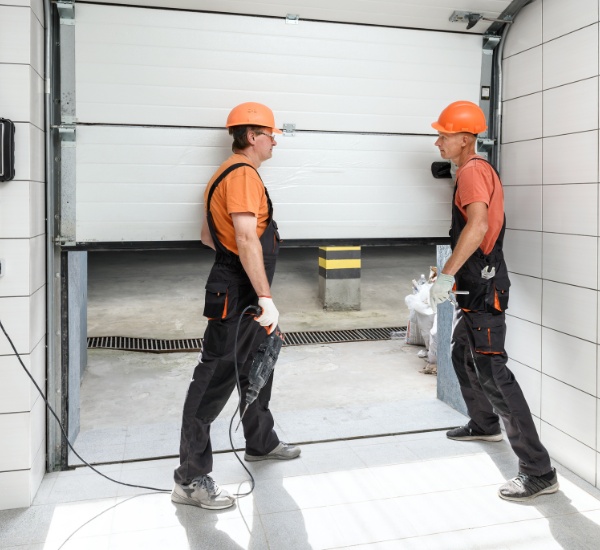
Nine times out of ten, it's in the car
On a phantom-operation call, the first place we look is the client's car — console, glovebox, seat pocket. A button wedged against loose change behaves exactly like a ghost with a schedule.
The battery-pull test settles it in a weekend: remove the batteries from every remote, and if the door stays put, reintroduce them one at a time until the culprit shows itself.
When It's the Logic Board
If remotes, wall wiring, and the neighbor theory are cleared, the board is what remains. Surge damage is the usual trigger, and on an opener old enough to have a fragile board, replacement often beats a board transplant. Most opener repairs run $100 to $300; when board work climbs past that neighborhood, we'll say so and show the new-opener math.
Is a Self-Opening Garage Door a Security Risk?
Treat it as one until it's solved. An open garage is an invitation, and most garage break-ins happen quietly during the day, not at night. Until the cause is fixed: lock the door between garage and house, keep remotes out of cars parked in the driveway, and photograph valuables near the opening. If your opener predates rolling codes, it was never as secure as you assumed — fixing the phantom and upgrading the opener solve the same problem at once.
"Highly Recommended!! The repair guy arrived 1 hour early for a quote but actually replaced the motor before our scheduled appointment." — Evan Bowden, Google Review
What We See Most Often in the Valley
Between the heat and the housing stock, the San Fernando Valley produces more phantom-operation calls than anywhere else we serve. Cars in driveways cook their remotes past design temperature for weeks at a time, and the neighborhoods around our Cantara St shop in Reseda still carry first-generation openers on perfectly good doors. The pattern is common enough that we can usually name the cause over the phone.
If your door is running itself, call (818) 919-0785 Monday through Friday, 8 AM to 6 PM, or request a free estimate online and we'll schedule a weekday visit that works for you.
Phantom Garage Door FAQs
The questions we hear most about garage doors that open on their own.
On older openers with fixed dip-switch codes, yes — a nearby remote on the same frequency with a near-matching code can trip your door. Openers built since the mid-1990s use rolling codes that change after every press, preventing cross-talk. If your remote has dip switches, your opener is old enough to be vulnerable.
Work through it in order: pull the batteries from every remote to test for a stuck button, erase the opener's memory and reprogram remotes fresh, then disconnect the wall-button wires at the opener to rule out a short. If the phantom runs continue through all three, the logic board needs a professional diagnosis.
Treat it as a security issue until solved. Lock the door between garage and house, keep remotes out of cars parked outside, and don't leave valuables visible from the opening. The door itself is not a physical danger from phantom operation — the risk is unauthorized access.
Yes. Holding the learn button until the LED goes out wipes every stored remote and keypad code. You will need to reprogram each one afterward — usually a button press on the learn button followed by a press on each remote. It costs nothing and removes any stray codes the receiver has collected.
Often nothing — a stuck remote button is free to fix. When the fault is in the opener, most repairs run $100 to $300, and a wall-button or wiring fix sits at the low end. We diagnose on site and give a free, itemized estimate before any work begins.
A modern opener with a rolling code eliminates fixed-code cross-talk, and wifi models add phone alerts every time the door moves, which makes any phantom run obvious within minutes. Our smart garage door openers guide covers the models we install and service.
Keep Reading
More guides from the EM Garage Doors team.