
Bent Garage Door Track: Straighten It or Replace It?
A bent track makes the door grind, stall, or jump the rails entirely. Some bends straighten cleanly; others mean a new track section. Here's the difference — and why spring tension comes before any of it.
Minor track bows can be straightened in place; kinked, twisted, or spread-open sections need replacement. Either way, the door must be secured and relieved of spring tension first — bent track work is a technician job, not a vise-grip job. Most repairs land in our $150–$500 range.
The first sign is usually a sound: a grind or a pop at the same height on every cycle. Then the door starts slowing at that spot, or shuddering, and one day a roller escapes the rail altogether. That's a bent track announcing itself the way bent tracks do — gradually, then suddenly.
Hillside neighborhoods like Chatsworth and Porter Ranch, with steep driveways and tight turn-arounds, produce more bent-track calls for us than anywhere else. Bumpers find doors. But tracks also bend without any help from a car, and the fix depends on which kind of bend you have.
How Tracks Get Bent
- Vehicle impact — the classic. Backing out before the door is fully open pushes the door into its own track, folding the vertical rail.
- An off-track event. When rollers escape and the door tilts, the track takes punishment as everything grinds crooked.
- Loose brackets. Track bolts vibrate loose over years; a track no longer anchored square to the frame flexes until it stays bent.
- Settling and quakes. LA homes move — slowly with the soil, abruptly with seismic events. A frame that shifts a quarter inch puts the track out of plumb, and rollers pinch at the same spot on every cycle until the metal yields.
- Storage collisions. Shelving, ladders, and bikes leaning against a vertical track deform it a little at a time.
Straighten or Replace? Reading the Bend
Tracks come in two runs per side: the vertical rails beside the opening and the horizontal (or radius) sections that carry the door overhead. The straighten-or-replace call follows the geometry of the damage:
| Damage | Straighten or replace | Why |
|---|---|---|
| Slight bow in a vertical rail | Straighten in place | Gradual bends in straight sections respond to clamps and careful leverage |
| Sharp kink at a single point | Replace the section | Cold-working a crease back weakens the steel; it re-bends under load |
| Bend in the radius (curve) section | Usually replace | The curved profile can't be re-formed true by hand; rollers bind in an imperfect radius |
| Track spread open (mouth widened) | Replace | Widened lips no longer capture roller stems; the door escapes under load |
| Twisted track section | Replace | Twist puts the rollers in a bind the full height of the section |
| Rust-thinned track (coastal or sprinkler exposure) | Replace | Metal lost to rust doesn't come back; straightening cracks it |
The pattern to notice: gentle bows in straight runs are recoverable; anything sharp, twisted, spread, or rusty is a new section. Sections are standard parts, and swapping one is routine work for a technician with the door secured — far cheaper than replacing the door the bent track is slowly destroying.
Why the Door Must Be Tension-Free First
This is the part of the job that makes it professional territory. The track is under load from three directions at once: the door's weight riding the rollers, the springs pulling through the cables, and the fasteners holding the rail to the frame. Loosen the wrong bolts on a loaded system and the track shifts, the door drops a few inches, or a cable comes off its drum — the drum and its neighbors live under spring tension even with the door closed and the opener unplugged.
So the sequence is always: clamp the door, relieve spring tension where the work requires it, then straighten or swap the section and re-anchor everything square. When a bent track came from an off-track door, the full job is exactly the process in our off-track repair guide — securing, realigning, re-seating, and re-testing. The bent rail is one chapter of that repair.
Roller Pinching: the Hidden Second Repair
A bent track doesn't just grind — it pinches. Roller stems squeeze against the deformed rail, flat-spotting the wheels and bending the stems themselves. Re-form the track without touching the rollers and the door runs quiet for a week, then the damaged rollers start the grinding all over again. That's why track service should always include a roller inspection: worn or pinched rollers get replaced in sets, and quality sealed-bearing rollers cost little more than budget ones while running years longer.
Listen for the signature
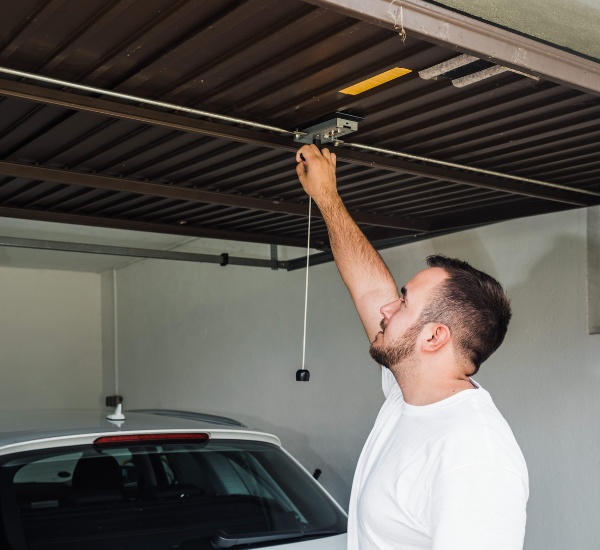
A bend announces itself as a noise at one consistent height. Sensor problems reverse doors; opener problems stop them. A door that grinds at the same spot every cycle is telling you it's the track.
Catch it early and the fix is a straightening visit. Grind for months and you're pricing rollers, possibly a cable rubbed at the pinch point — our cable guide covers that cascade.
What Bent Track Repair Costs in Los Angeles
Straightening a single bowed vertical section sits toward the lower end of the typical $150 to $500 repair band. Replacement sections cost more — parts for the section, plus the labor of securing the door and re-anchoring — and jobs that include roller sets or follow an off-track event land in the upper half. Rust-thinned track, common within sight of the coast, usually means both sides eventually; salt air doesn't negotiate. Our garage door track repair service quotes on site, free, before any work; if the track is fine and the real cause is elsewhere, you'll hear that instead.
For doors that have bent the same section twice — usually a too-short driveway exit or a stubborn teenage driver — we'll also re-check bracket anchoring and door timing, because a track that keeps meeting a bumper is a usage problem as much as a hardware one.
"Very professional, would recommend his service" — Chong Li, Google Review
What We See Most Often on Track Calls
Across Northridge, Granada Hills, and the streets around our Reseda shop, the same story repeats: a slow grind ignored for months, then a door that jumps the rails on a Tuesday morning. The straighten-versus-replace verdict usually takes minutes on a ladder — the door-securing is what takes the time. Grinding at one spot, every cycle? Stop cycling the door and call (818) 919-0785, Monday through Friday, 8 AM to 6 PM, for a free on-site estimate from our Los Angeles garage door repair team.
Bent Track FAQs
The track questions we answer most on service calls.
We advise against it. The track is under load from the door's weight and the spring system, and loosening the wrong hardware on a loaded door can drop a section or release a cable from its drum. A technician clamps the door, relieves tension where needed, and works the track safely — straightening in place when the bend allows, replacing the section when it doesn't.
Straightening a single bowed vertical section usually sits in the lower half of the typical $150 to $500 repair range. Replacing a section costs more, and jobs that include rollers or follow an off-track event land higher. The estimate is free and itemized on site before any work begins.
The signature is a grind, pop, or shudder at the same height on every cycle, sometimes with visible daylight gaps between roller and rail, or a rail that's visibly out of line with the door's edge. A straightedge or level against the vertical rail will show a bow; sharp kinks and spread lips are visible on inspection.
Not automatically. If one side is bent from a specific impact and the other is straight, true, and rust-free, replacing the damaged side is standard. When the cause is age, settling, or corrosion — things that affect both sides equally — doing both at once avoids paying the labor twice.
Yes — it's one of the most common precursors. A spread or kinked section lets roller stems escape under load, and the door jumps the rails. If your door is already off track, keep it still and see our off-track repair guide; the bent section is repaired as part of that job.
Straightening a section is usually done within a single visit. Replacing sections is usually a one-visit job when the parts are on the truck; ordered sections add a few days. Every job ends with a balance test and several powered cycles to confirm the door runs true before the technician leaves.
Keep Reading
More guides from the EM Garage Doors team.