
Garage Door Cable Repair: Signs, Safety & Costs
A snapped lift cable leaves the door tilted, stuck, or off its track — and the cables stay under spring tension even at rest. Here's how to spot fraying early, why this repair is never DIY, and what it costs.
A snapped lift cable leaves the door tilted or stuck, and the cables stay under spring tension even at rest — so cable repair is never a DIY job. Look for frayed strands near the drums and call a pro. Cables are replaced as a matched pair, often alongside spring or roller service.
It usually announces itself: a bang, a sag, a door sitting crooked in the opening — one side up, one side down. That's a snapped lift cable from inside the garage. Sometimes it's quieter, a frayed strand at a time, the door getting jerkier for months until the cable lets go for good.
Lift cables are the connection between your door's weight and the spring system that carries it. They're also the repair we're firmest about: cable work is never DIY, for one reason — tension. Here's how to recognize a failing cable early, what a technician does, and what drives the cost.
What Lift Cables Actually Do
On a torsion-spring door — standard on homes built since the 1980s — the cables wrap around drums at each end of the spring shaft above the door. As the door closes, the springs wind and the cables pay out; as it opens, the springs unwind and the cables reel the door up. Extension-spring doors, common in older Van Nuys and Panorama City garages, run their cables through pulleys. In both designs, the cable is the only thing handing the door's weight to the spring system.
A cable failure is never just the cable: the door's weight shifts instantly to the other side, tilting the section, dragging rollers out of the track, and leaving the door hanging on hardware never meant to carry it alone.
Signs a Cable Is About to Snap
- Frayed strands near the drums or bottom brackets — the classic early warning. Look for a frizzy, brush-like section of cable.
- Rust along the cable — coastal homes near Santa Monica and Marina del Rey fight salt air; Valley homes more often see it where sprinkler overspray or a roof leak wets the door.
- A jerky, uneven door — one that stutters or rides higher on one side as it moves.
- A door that's visibly tilted in the opening, or a cable that's gone slack and dangles.
- Bang, then a crooked door — the after-the-fact version. If you're reading this paragraph standing in front of one, stop cycling the door.
Cables and springs age on the same clock — roughly a decade-plus of normal use in Valley conditions, where heat dries lubricant and works metal faster than coastal climates. A fraying cable usually means its neighbors (springs, rollers, drums) are equally due, which is why we inspect the whole system on any cable call.
| What you're seeing | Likely situation | Action |
|---|---|---|
| Frayed strands, door still working | Cable near end of life | Stop cycling; schedule replacement before it snaps |
| Cable snapped, door tilted but in track | One cable failed; door is unbalanced | Keep door closed and still; professional service |
| Cable snapped, door off track | Failure cascaded to the track | Off-track repair plus cable pair; keep everyone clear |
| Rusty cable, no fraying yet | Corrosion working through strands | Replacement soon; rust hides internal wear |
| Cable off its drum, coiled loose | Cable jumped a worn or loose drum | Do not touch; drum and cable both need service |
Why Cable Repair Is Never DIY
Everything dangerous about garage door work is concentrated here. The springs are wound to hold the full weight of the door, and the cables are the delivery line for that stored energy — even with the door closed and the opener unplugged. The Door & Access Systems Manufacturers Association (dasma.org) publishes safety material on precisely this: torsion assemblies under tension belong to trained people with the right bars, clamps, and winding technique. A cable released the wrong way whips; a slipping shaft spins a drum like a winch. No repair is worth an ER visit.
It's also, honestly, easy to do badly. A cable wound one turn short of specification, or a set screw not torqued, produces a door that works for three weeks and then fails again — this time taking the drum or the track with it.
How a Technician Replaces Lift Cables
- Secure the door. Clamps and locking pliers hold the door in the down position so nothing moves during the work.
- Relieve spring tension. With winding bars, the technician unwinds the torsion springs to a safe state — this is the step that requires training.
- Replace the pair. Both cables come off and matched new ones seat into the drums, wound to specification. One new cable against one old one is a lopsided door waiting to happen.
- Inspect the neighbors. Drums for groove wear, rollers for flat spots, springs for gap and corrosion — the cable rarely fails alone.
- Rewind and balance-test. Springs re-tension, then the door is lifted by hand: it should move smoothly and hold at chest height.
- Cycle-test. Several powered cycles confirm the cables track the drums cleanly.
Our garage door cable repair service handles this end to end, and when the failure has already pulled the door crooked or off its rails, it runs alongside our off-track door repair.
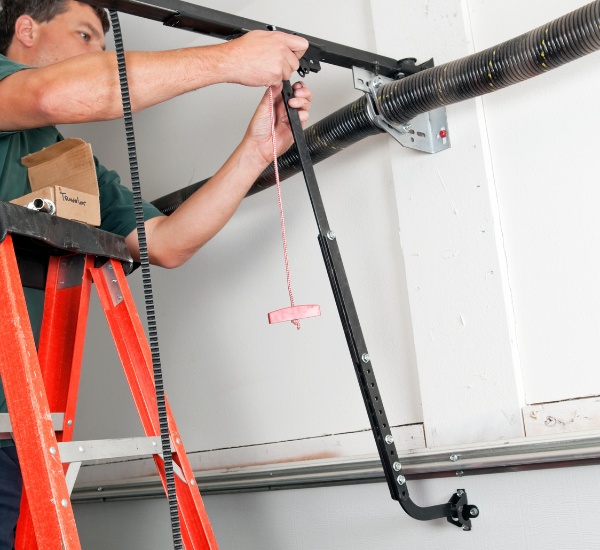
The cable rarely fails alone
Cables, springs, drums, and rollers wear out on the same schedule. When we replace a cable pair, we show you the condition of everything spinning on that shaft — the cheapest repair is the one you don't repeat in a year.
Springs that are equally worn are worth replacing in the same visit; our spring replacement guide covers the signs and the costs.
What Drives the Cost
Straightforward cable-pair replacement on an otherwise healthy door sits in the lower half of the typical $150 to $500 repair range. The price climbs with what the failure took with it: springs replaced in the same visit, drums re-seated, rollers done in sets, track straightened after the door jumped. Wider and heavier doors carry more cable and stronger springs, nudging parts and labor upward. We inspect first, quote line by line, and you approve the price before work starts — how we run every job out of our Reseda shop.
"Highly Recommended!! The repair guy arrived 1 hour early for a quote but actually replaced the motor before our scheduled appointment." — Evan Bowden, Google Review
Preventing the Next Snap
Cables fail from age, moisture, and neglect — two of the three are manageable. Keep sprinkler overspray off the door, wipe rust blooms early, and tune the system annually: lubricated springs and rollers, hardware re-snugged, cables inspected at the drums where wear concentrates. A ten-minute look during a tune-up catches the fray months before the bang — which is why most cable replacements in Canoga Park and Winnetka happen on a scheduled visit, not an urgent one.
Cable already frayed or snapped? Keep the door closed and still, and call (818) 919-0785 Monday through Friday, 8 AM to 6 PM, for a free on-site estimate.
Garage Door Cable FAQs
The cable questions we answer most from LA homeowners.
You shouldn't try, by hand or with the opener. With one cable gone, the door's weight hangs unevenly on the springs and the remaining hardware, and cycling it can pull the door off its track or damage the drums. Keep the door closed and still until a technician secures it.
A matched cable pair on an otherwise healthy door usually lands in the lower half of the typical $150 to $500 repair range. Costs rise when springs, drums, rollers, or track work join the job. We inspect and quote on site, free, before any work begins.
Both, always. The two cables age together, and a new cable paired with a worn one lifts unevenly — which accelerates wear on the springs, the drums, and the door itself. Matched pairs are standard practice and barely differ in price.
Age and cycles first: cables fray strand by strand over a decade-plus of use. Moisture accelerates it — coastal salt air, sprinkler overspray, roof leaks. The third cause is a neighboring failure: a worn drum groove or a bad roller that chafes the cable until it parts.
On a standard residential door with parts on the truck, cable replacement is usually done in a single visit, including balance and cycle tests. If the failure damaged the track or drums and parts must be ordered, the timeline is confirmed after the inspection.
Yes — one of the most common off-track causes. When one cable releases, that side drops and tilts, dragging rollers out of the track. If that's what you're looking at, keep everyone clear: the door must be secured and re-seated before the cable pair is replaced.
Keep Reading
More guides from the EM Garage Doors team.