
Garage Door Only Opens Partway? A Diagnostic Ladder
When a garage door rises a few inches and stops, the cause hides in one of four places: travel-limit settings, opener up-force, springs that can no longer finish the lift, or a track bind. Here is the order to check them in — and the point where the DIY path ends.
A garage door that opens a few inches and stops is usually one of four things: travel-limit settings, low up-force on the opener, a broken or binding torsion spring, or a track obstruction. Test the door by hand with the opener disengaged first — if it feels heavy or sticks, stop and call a pro.
The partway-open door is the strangest failure in garage door work, because the door is neither broken nor working. It rises six inches, twelve inches, sometimes halfway — then quits, reverses, or just hangs there. Customers in Burbank and across the Valley describe it the same way every time: "it acts like it wants to open." What is actually happening is that the system ran out of one of the four things it needs to finish the stroke: permission (limits), power (force), lift (springs), or a clear path (track).
The ladder below finds which one, in the order that separates safe homeowner checks from pro-only territory. Follow it exactly — the first step exists to protect you from the fourth.
The Diagnostic Ladder
| Step | What to check | What it tells you |
|---|---|---|
| 1. Manual lift test | Close the door fully, disengage the trolley, lift by hand | Heavy or sticking door means springs or track — stop and call a pro |
| 2. Path inspection | Look for debris, bent track sections, frozen rollers | A bind found here explains the stall without touching settings |
| 3. Watch where it stops | Run the opener and note if the stopping point is identical every cycle | Consistent stopping point points to travel limits; random stopping points to force or binding |
| 4. Listen while it runs | Straining motor versus clicking with no movement | Strain means the door is too heavy for the opener; hum-plus-click points to opener electrical faults |
Step One, Because It Is the Safety Gate: Lift It by Hand
Before touching any button or dial, close the door fully and pull the red emergency-release handle to disengage the trolley. Lift the door by hand. A balanced door should rise smoothly and stay open on its own around waist height. If it takes real effort, sags back down, or stops dead at a point in the travel, the problem is mechanical — springs, cables, or track — and that is where your DIY ends. Torsion springs are under enough stored force to cause serious injury; spring and cable work is strictly professional work, and every experienced tech in this trade will tell you the same thing. Call it a rule with a reason.
The manual test matters for a second reason: it keeps you from "fixing" the symptom in a way that makes the door dangerous. The instinct when a door opens partway is to raise the opener's force setting so it powers through. Do not. Force settings are safety settings — turn them up to overpower a heavy door and you get a door that will strain through anything, including the reversal that should protect a child or a pet underneath it.
Cause: Travel Limits Set Short
The opener stops where it believes "open" is. If the up-travel limit drifted after a power event, a battery swap, an interrupted cycle, or simply years of running, the opener executes a perfect trip to the wrong destination: six inches, half height, whatever the setting says. The signature is precision — the door stops at the same spot every single time, runs at normal speed, and reverses cleanly on command. Many openers let you re-learn travel via a button sequence or app, and owners do manage it. The caution is the interaction: limits, force, and safety reversal are tuned together, and a botched limit setup produces a door that slams into the header or refuses to reverse. If the door behaves at all aggressively after an adjustment, hand it off. For the mirror fault — a door that closes and then pops back open — the closes-then-reopens guide covers that variant.
Cause: Up-Force Set Too Low
Up-force is the ceiling on how hard the opener may push while raising the door. Set below what the door currently needs, the opener interprets the resistance as an obstruction and quits mid-lift — often at a similar height each time, which is why people confuse it with a limit problem. The distinguishing test is the manual lift from step one: a door that feels normal by hand but quits under power points at settings; a door heavy by hand points at springs. Legitimate force adjustment is a fine-tuning job for a door in good mechanical order. Force adjustment used to mask a heavy door is a hazard wearing a fix's clothing.
Cause: Broken or Worn Springs Lifting Only Partly
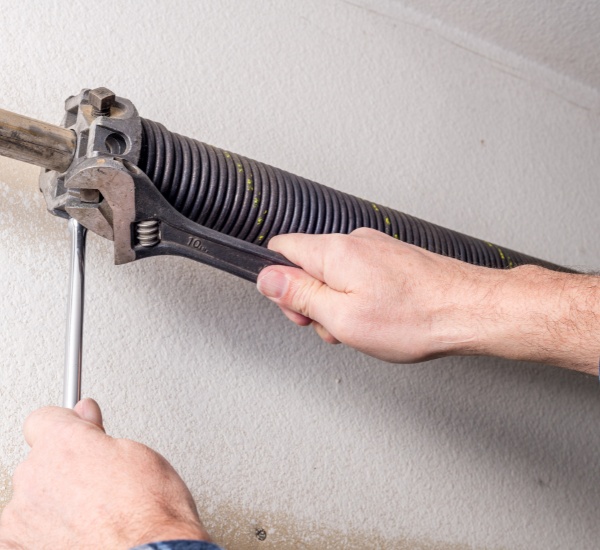
This is the big one, and on LA's older housing stock it is the most common real cause we find. Torsion springs do the actual lifting; the opener mostly steers. When a spring breaks you sometimes get the famous loud bang from the garage — but not always, and on two-spring doors the failure can be quieter: one spring snaps, the survivor carries a share of the load, and the door rises a few inches before the math runs out. That is the classic partway-open signature. Other tells: a visible gap in the spring coil, one stretched spring next to a slack one, cables slightly off their drums, and a door that is distinctly heavy by hand. Homes from the 1950s through the 70s around the Valley often carry original or long-overdue springs on heavier solid doors — heat cycling through decades of summers is what wears them out. Spring replacement typically runs $150 to $350, and it is the repair that makes every other setting meaningful again. Our torsion spring replacement service handles it same-visit in most cases.
Cause: Track Bind and Roller Problems
The last rung is physical obstruction. A bolt backed out of a track bracket, a track section knocked inward by a car or a basketball hoop mishap, rollers seized dry, or debris jammed at a splice — any of them can stop a door at a repeatable height that mimics a limit fault. Inspect both tracks top to bottom for symmetry, gaps between roller and track wall, and shiny scrape marks where metal has been rubbing. Minor cleaning and lubrication is homeowner territory; realigning a track means loosening brackets under door tension and belongs to a technician. If the door is fully off its track, that is a different repair entirely — our off-track repair guide covers it.
When to Call — and What Not to Do
Call us if the manual test shows a heavy door, if you can see a gap in a spring, if a cable is slack or off its drum, if the door stops hard or slams, or if settings adjustments have not produced a door that runs smoothly and reverses on a beam break. Until then: do not crank force settings, do not cycle a straining opener repeatedly, and do not leave a partly-open door unattended — it is one interrupted cycle from coming down fast. For doors that will not open at all rather than partly, the garage door won't open guide covers that failure separately. Our garage door repair service in Los Angeles runs these diagnoses daily, Monday through Friday 8 AM to 6 PM, with free estimates before work begins.
"Highly Recommended!! The repair guy arrived 1 hour early for a quote but actually replaced the motor before our scheduled appointment." — Evan Bowden, Google Review
To book a diagnosis, call (818) 919-0785 or use the contact page.
What We Check on Arrival
The visit runs the same ladder, with instruments: spring condition and balance, cable seating, track alignment, roller wear, then travel and force settings verified against the door's actual weight. You get the cause in plain language and a price approved before work starts. If the fix is settings, the visit is short and inexpensive; if it is springs, most replacements are done same-visit. The garage door repair cost guide shows the typical ranges for each of these repairs.
Partway-Open Door FAQ
Questions we field about doors that stop short.
Four causes cover most cases: a travel-limit setting that tells the opener to stop early, an up-force setting too low to finish the lift, a broken or binding spring that cannot carry the door's weight, or a track obstruction binding the rollers. Test the door by hand first — a heavy door points to springs, a smooth one to settings.
Look for a visible gap in the torsion spring coil above the door, a loud bang you heard earlier, a door that feels very heavy when lifted by hand, or two springs where one looks stretched and the other is not. On wider doors, one broken spring can still lift the door a few inches — partway.
Many openers expose limit adjustment via buttons or an app, and owners do adjust them successfully. The cautions: never raise the opener force to overpower a heavy door — that masks spring failure and wrecks the safety reversal. If the door feels heavy by hand, skip the settings and call a pro.
Up-force is how hard the opener is allowed to push while raising the door. Set too low, the opener gives up partway; set too high, it will strain through problems it should stop for and can crush an obstruction. It is a safety setting, not a power dial — it gets tuned to the door, not to the symptom.
No. Every partial cycle strains the opener, and a door with a failing spring can stall mid-lift or come down harder than intended. Stop using the opener, do not stand or park under the door, and schedule service — spring and cable work in particular is not a homeowner repair.
Settings adjustments are the least expensive fix. Spring replacement typically runs $150 to $350, and track or roller work varies with the repair. A proper diagnosis keeps the bill honest — we quote free on site and approve the price before starting any work.
Keep Reading
Related troubleshooting guides and services.